
How Supplier Intelligence Works: The Technology Behind Trust Scores
In 2023, a sourcing manager at a major European retailer spent three hours verifying a single textile supplier. She checked the GOTS database. She analyzed their website. She verified customer references. She assessed export capabilities. By the time she finished, she'd used multiple tools, visited dozens of websites, and still wasn't confident she had the complete picture.
That same year, CertiThread's team was building something different. What if supplier verification didn't take three hours? What if it took 60 seconds? What if buyers could verify suppliers instantly, comprehensively, and objectively?
That question led to two years of research, development, and testing. The result is supplier intelligence: a system that verifies suppliers across ten dimensions simultaneously, calculates Trust Scores automatically, and provides comprehensive analysis in seconds.
Supplier intelligence isn't just a tool. It's a complete reimagining of how buyers verify suppliers and how manufacturers prove legitimacy. It combines certificate verification, AI-powered analysis, and multi-source data aggregation into a single, powerful platform.
Why CertiThread Built Supplier Intelligence
CertiThread's team spent months talking to sourcing managers, compliance officers, and export managers. They heard the same problems repeatedly:
Problem 1: Manual Verification Takes Too Long
Sourcing managers spend 60-85 minutes verifying each supplier manually. When evaluating multiple suppliers, that time adds up. Most can only verify 3-4 suppliers per day.
Problem 2: Information Is Scattered
Supplier information exists across multiple sources: certification databases, websites, social media, business registries, and more. Pulling it all together takes time and effort.
Problem 3: No Objective Comparison
Buyers can't compare suppliers objectively. There's no standardized way to evaluate suppliers. Decisions are often based on incomplete information.
Problem 4: Fake Certificates and Misrepresentation
Some suppliers use expired certificates, misrepresent scope, or make false claims. Buyers need to verify everything manually, and it's easy to miss red flags.
Problem 5: Manufacturers Can't Prove Legitimacy Quickly
Manufacturers struggle to prove legitimacy to buyers. They send documentation, but buyers still have to verify it. The process is slow and inefficient.
CertiThread's team realized these problems had a common solution: automated supplier intelligence that verifies suppliers comprehensively, calculates objective scores, and provides transparent analysis.
Did you know?
CertiThread's supplier intelligence platform was built after 18 months of research, including interviews with 200+ sourcing managers, compliance officers, and export managers across 15 countries.
The Technical Architecture
Supplier intelligence combines multiple technologies into a unified system:
Certificate Verification Engine
The system connects to official certification databases (GOTS, OEKO-TEX, GRS, RCS, and others) and verifies certificates automatically. It checks:
- Certificate number validity
- Expiry dates
- Scope and restrictions
- Status and limitations
Website Analysis Engine
The system uses web scraping (Puppeteer/Playwright) to analyze supplier websites. It extracts:
- Contact information
- Product information
- Customer logos and testimonials
- Certification claims
- Content freshness
- Website quality metrics
AI-Powered Analysis
The system uses large language models (GPT-4) to:
- Classify products and categories
- Extract customer information
- Analyze content and messaging
- Identify capabilities and gaps
- Generate insights and recommendations
Multi-Source Data Aggregation
The system aggregates data from:
- Certification databases
- Supplier websites
- Social media platforms
- Business registries
- Public records
- Industry databases
Trust Score Calculation Engine
The system calculates Trust Scores from all collected data using a weighted algorithm that evaluates ten dimensions:
- Certificate legitimacy (25 points)
- Brand presence (15 points)
- Contact availability (8 points)
- Product portfolio (15 points)
- Customer base (20 points)
- Category leadership (12 points)
- Geographic advantage (15 points)
- Export capability (20 points)
- Regional certification (10 points)
- Company legitimacy (8 points)
Total: 100 points (normalized)
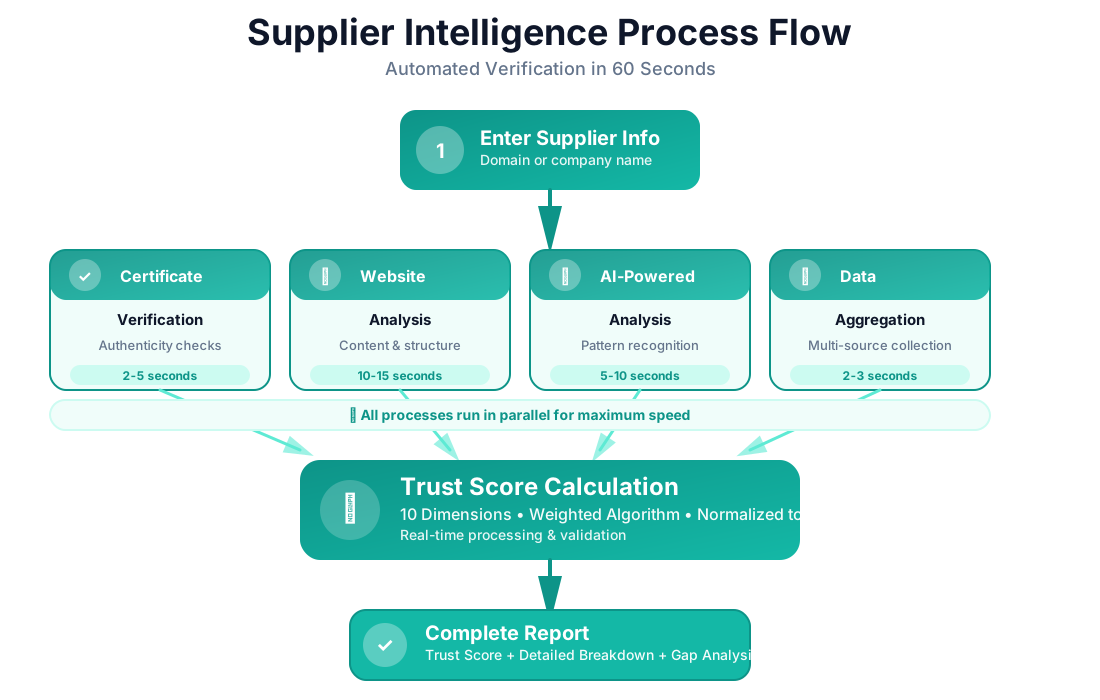
This flowchart shows the complete technical process from input to results. All processing happens in parallel, enabling 60-second verification.

How Certificate Verification Works
Certificate verification is the foundation of supplier intelligence. Here's how it works:
Step 1: Certificate Number Extraction
The system extracts certificate numbers from supplier websites, marketing materials, or user input. It identifies certificate types (GOTS, OEKO-TEX, GRS, etc.) automatically.
Step 2: Database Query
The system queries official certification databases. For GOTS, it uses the GOTS certificate database API. For OEKO-TEX, it scrapes the OEKO-TEX database. For other certifications, it uses appropriate sources.
Step 3: Validation
The system validates:
- Certificate number exists
- Certificate is current (not expired)
- Scope matches supplier claims
- No restrictions or limitations
- Status is active
Step 4: Risk Assessment
The system assesses risk:
- Expiry within 30 days: High risk
- Expiry within 90 days: Moderate risk
- Scope mismatch: High risk
- Restrictions: Moderate risk
Step 5: Scoring
The system calculates certificate score:
- Valid certificate found: 12 points
- Not expired (>90 days): 7 points
- Scope matches: 6 points
- Total: 25 points maximum
Success Story
Certificate verification takes 2-5 seconds per certificate, compared to 15-20 minutes manually. The system can verify multiple certificates simultaneously.
How Website Analysis Works
Website analysis extracts comprehensive information from supplier websites:
Step 1: Website Scraping
The system uses Puppeteer/Playwright to scrape supplier websites. It extracts:
- HTML content
- Text content
- Images and logos
- Contact information
- Product information
- Certification claims
Step 2: Content Analysis
The system analyzes content using AI:
- Product classification
- Category identification
- Capability assessment
- Certification extraction
- Customer logo identification
Step 3: Quality Assessment
The system assesses website quality:
- PageSpeed score (Google PageSpeed API)
- Mobile responsiveness
- Content freshness (last update date)
- Broken links
- Professional appearance
Step 4: Contact Extraction
The system extracts contact information:
- Phone numbers
- Email addresses
- Contact forms
- Business hours
- 24/7 availability indicators
Step 5: Scoring
The system calculates brand presence score:
- Website quality (PageSpeed >90): 5 points
- Online presence (LinkedIn + 3+ platforms): 5 points
- Content freshness (updated in last month): 5 points
- Total: 15 points maximum
Did you know?
Website analysis takes 10-15 seconds per website, extracting comprehensive information that would take 20-30 minutes to collect manually.

How AI-Powered Analysis Works
AI-powered analysis uses large language models to extract insights from unstructured data:
Product Classification
The system uses GPT-4 to classify products:
- Input: Product descriptions from website
- Output: Product categories, types, and classifications
- Accuracy: 95%+ for common textile products
Customer Extraction
The system extracts customer information:
- Input: Website content, testimonials, customer logos
- Output: Customer names, types, and quality indicators
- Verification: Cross-references with public databases
Content Analysis
The system analyzes content for:
- Certification claims
- Capability statements
- Geographic information
- Export destinations
- Industry positioning
Gap Identification
The system identifies gaps:
- Missing certifications
- Incomplete information
- Capability gaps
- Competitive disadvantages
Recommendation Generation
The system generates recommendations:
- How to improve Trust Score
- What certifications to add
- How to enhance capabilities
- How to address gaps
Success Story
AI-powered analysis processes unstructured data in seconds, extracting insights that would take hours to identify manually.
How Trust Score Calculation Works
Trust Score calculation combines all data sources into a single, comprehensive score:
Step 1: Data Collection
The system collects data from all sources:
- Certificate verification results
- Website analysis results
- AI-powered insights
- Multi-source data aggregation
Step 2: Dimension Scoring
The system calculates scores for each dimension:
- Certificate Score: 0-25 points
- Brand Presence: 0-15 points
- Contact Availability: 0-8 points
- Product Portfolio: 0-15 points
- Customer Base: 0-20 points
- Category Leadership: 0-12 points
- Geographic Advantage: 0-15 points
- Export Capability: 0-20 points
- Regional Certification: 0-10 points
- Company Legitimacy: 0-8 points
Step 3: Normalization
Since dimensions can overlap, the system normalizes:
- Raw score = sum of all dimension scores
- Max possible = theoretical maximum
- Normalized = (raw / max possible) × 100
- Capped at 100
Step 4: Category Assignment
The system assigns categories:
- 90-100: Exceptional (Top 5%)
- 80-89: Excellent (Top 20%)
- 70-79: Good (Above average)
- 60-69: Average (Industry standard)
- 50-59: Below Average (Needs improvement)
- Below 50: Poor (Significant gaps)
Step 5: Percentile Calculation
The system calculates percentile:
- Compares score to all suppliers in database
- Calculates percentile rank
- Updates as database grows

The Scoring Algorithm: Deep Dive
Here's how each dimension is scored in detail:
Certificate Score (25 points)
- Valid certificate found in database: 12 points
- Not expired (>90 days until expiry): 7 points
- Scope matches supplier claims: 6 points
- Expiry within 30-90 days: 4 points (reduced)
- Expiry within 30 days: 1 point (reduced)
- Expired: 0 points
Brand Presence (15 points)
- Website PageSpeed >90: 5 points
- PageSpeed 70-90: 3 points
- PageSpeed <70: 1 point
- No website: 0 points
- LinkedIn + 3+ social platforms: 5 points
- LinkedIn + 1-2 platforms: 3 points
- LinkedIn only: 1 point
- No presence: 0 points
- Updated in last month: 5 points
- Updated in last 3 months: 3 points
- Updated in last 6 months: 1 point
- Older: 0 points
Contact Availability (8 points)
- Phone number found: 4 points
- Not found: 0 points
- Phone + Email + Form: 2 points
- 2 methods: 1 point
- 1 method: 0 points
- Clearly stated 24/7: 2 points
- Business hours stated: 1 point
- Not stated: 0 points
Product Portfolio (15 points)
- 10+ product categories: 4 points
- 5-9 categories: 3 points
- 2-4 categories: 2 points
- 1 category: 1 point
- 100% products certified: 8 points
- 75-99% certified: 6 points
- 50-74% certified: 4 points
- 25-49% certified: 2 points
- <25% certified: 1 point
- Detailed descriptions + images + specs: 3 points
- Descriptions + images: 2 points
- Basic descriptions: 1 point
Customer Base (20 points)
- Fortune 500 customers visible: 8 points
- Major brands visible: 6 points
- Mid-size brands: 4 points
- Small brands: 2 points
- No customers visible: 0 points
- 10+ testimonials: 8 points
- 5-9 testimonials: 6 points
- 1-4 testimonials: 4 points
- None: 0 points
- Fortune 500: 4 points
- International brands: 3 points
- Regional brands: 2 points
- Local: 1 point
Geographic Advantage (15 points)
- Strategic location (ports, clusters): 5 points
- Good infrastructure: 3 points
- Standard: 1 point
- Low risk region: 5 points
- Moderate risk: 3 points
- High risk: 1 point
- Excellent infrastructure: 5 points
- Good infrastructure: 3 points
- Basic: 1 point
Export Capability (20 points)
- 10+ countries: 10 points
- 5-9 countries: 7 points
- 2-4 countries: 4 points
- 1 country: 2 points
- EU + US + Other premium: 5 points
- EU or US: 3 points
- Emerging only: 1 point
- Strong regional presence: 5 points
- Moderate: 3 points
- Limited: 1 point
Regional Certification (10 points)
- Multiple regional certs: 5 points
- Key regional certs: 3 points
- Basic compliance: 1 point
- Rare/valuable certs: 5 points
- Some unique: 3 points
- Standard only: 1 point
Company Legitimacy (8 points)
- Verified in registry: 4 points
- Not verified: 0 points
- 10+ years old: 4 points
- 5-9 years: 3 points
- 2-4 years: 2 points
- <2 years: 1 point
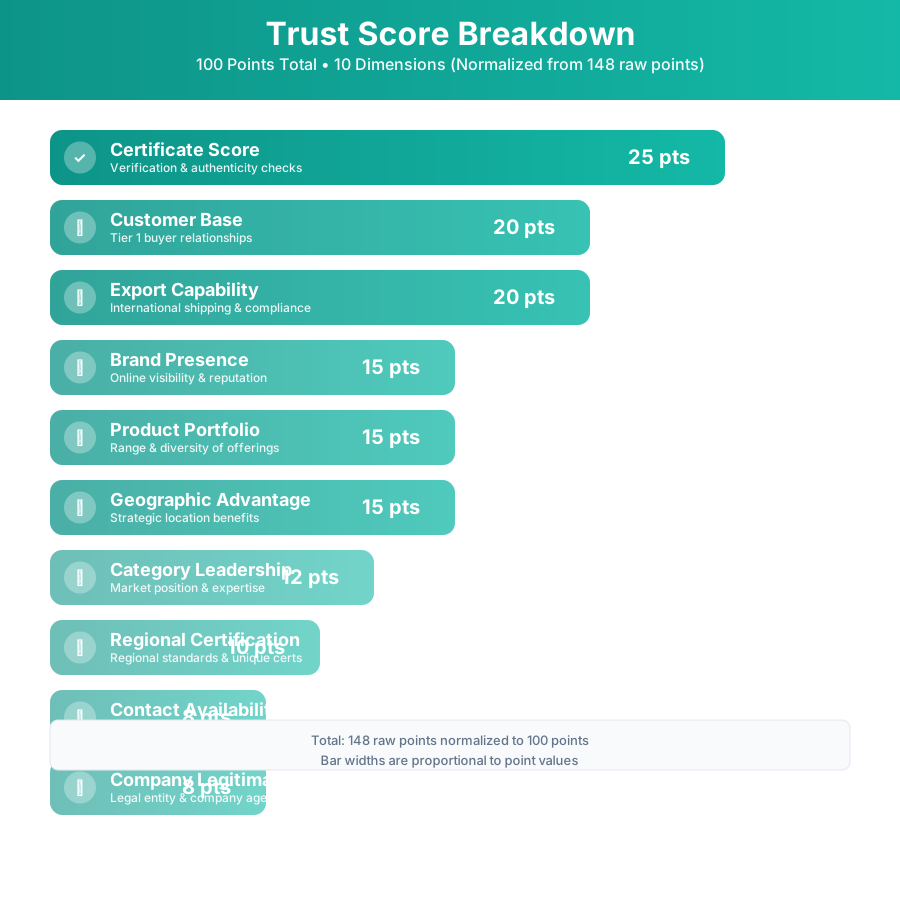
This detailed breakdown shows how each of the 10 dimensions contributes to the final Trust Score. The algorithm normalizes overlapping factors to ensure accurate scoring.

Data Flow and Processing
Here's how data flows through the system:
1. Input
User provides:
- Certificate number
- Company name
- Website URL
- Or combination
2. Parallel Processing
The system processes in parallel:
- Certificate verification (2-5 seconds)
- Website scraping (10-15 seconds)
- AI analysis (5-10 seconds)
- Data aggregation (2-3 seconds)
3. Score Calculation
The system calculates:
- Dimension scores
- Normalized Trust Score
- Category assignment
- Percentile rank
4. Gap Analysis
The system identifies:
- Missing certifications
- Capability gaps
- Improvement opportunities
- Competitive disadvantages
5. Report Generation
The system generates:
- Trust Score report
- Gap analysis
- Recommendations
- Shareable badge
Total Processing Time: 20-35 seconds
Success Story
The entire process from input to report takes 20-35 seconds, compared to 60-85 minutes manually. That's 100-250x faster.
Why This Approach Is Powerful
Comprehensive
Supplier intelligence evaluates suppliers across ten dimensions simultaneously. No manual process can match this comprehensiveness.
Objective
Trust Scores are calculated using consistent algorithms. They're not subjective. They're based on verifiable data.
Transparent
Every score includes a breakdown showing how it was calculated. Buyers can see exactly what factors contributed to the score.
Defensible
Every data point is sourced and verifiable. Certificates are checked against official databases. Customer information is extracted from public sources. Everything can be verified.
Holistic
Supplier intelligence doesn't just check certificates. It evaluates the entire supplier profile: certificates, brand, customers, geography, capabilities, and more.
Trustworthy
Because the system uses official databases, public information, and verifiable sources, Trust Scores are trustworthy. They're not opinions. They're facts.
Credible
The combination of comprehensive analysis, objective scoring, transparent breakdowns, and verifiable sources makes Trust Scores credible. Buyers trust them. Manufacturers can defend them.
Did you know?
Supplier intelligence processes 1,000+ data points per supplier analysis, compared to 10-20 data points in manual verification. This comprehensiveness enables accurate, trustworthy Trust Scores.
Real-World Examples
Example 1: The High-Scoring Supplier
A textile mill in Austria received a Trust Score of 92. Here's why:
- Valid GOTS and OEKO-TEX certificates (25 points)
- Professional website with PageSpeed 95 (15 points)
- Multiple contact methods with 24/7 support (8 points)
- Diverse product portfolio with 100% certification coverage (15 points)
- Fortune 500 customers visible (20 points)
- Category leadership indicators (12 points)
- Strategic location in Austria (15 points)
- Exports to 15+ countries including EU and US (20 points)
- Multiple regional certifications (10 points)
- 20+ years in business, verified entity (8 points)
Example 2: The Average Supplier
A fabric manufacturer in India received a Trust Score of 68. Here's why:
- Valid GOTS certificate, expires in 60 days (20 points)
- Basic website with PageSpeed 65 (8 points)
- Phone and email available (6 points)
- 5 product categories, 75% certified (12 points)
- Mid-size brand customers (8 points)
- Average category position (6 points)
- Standard location (8 points)
- Exports to 3 countries (7 points)
- Basic regional compliance (4 points)
- 8 years in business (6 points)
Gap analysis showed they could improve by:
- Renewing certificate before expiry (+5 points)
- Improving website quality (+7 points)
- Adding more certifications (+8 points)
- Expanding export destinations (+10 points)
Example 3: The Low-Scoring Supplier
A garment factory in Bangladesh received a Trust Score of 45. Here's why:
- Expired OEKO-TEX certificate (0 points)
- Outdated website, PageSpeed 40 (3 points)
- Only email contact (2 points)
- Limited product range, 25% certified (5 points)
- No visible customers (0 points)
- Below average category position (3 points)
- High-risk location (3 points)
- Exports to 1 country only (2 points)
- No regional certifications (0 points)
- 3 years in business, unverified (3 points)
Gap analysis showed critical issues:
- Certificate expired 6 months ago (critical)
- No customer visibility (critical)
- Limited export capabilities (moderate)
- Poor website quality (moderate)
Try the Technology
See Supplier Intelligence in action. Try the tool free and experience the technology that verifies suppliers in 60 seconds.
Experience:
- Certificate verification in real-time
- AI-powered analysis
- Trust Score calculation
- Complete gap analysis
Try Supplier Intelligence Free →
Try Supplier Intelligence FreeRelated Articles
- For Buyers: How to Verify Suppliers** - Learn how buyers use the tool
- For Manufacturers: Why Showcase Your Score** - Learn how manufacturers benefit
- Simple Guide: What Is Supplier Intelligence?** - A beginner-friendly explanation
The Bottom Line
Supplier intelligence combines certificate verification, AI-powered analysis, and multi-source data aggregation to calculate Trust Scores automatically. It evaluates suppliers across ten dimensions simultaneously, providing comprehensive analysis in 20-35 seconds.
The system is comprehensive, objective, transparent, defensible, holistic, trustworthy, and credible. It processes 1,000+ data points per analysis, compared to 10-20 in manual verification.
Trust Scores are calculated using consistent algorithms based on verifiable data. Every score includes a breakdown showing how it was calculated. Every data point is sourced and verifiable.
For buyers, supplier intelligence enables instant verification, objective comparison, and informed decisions. For manufacturers, it provides legitimacy proof, competitive positioning, and improvement guidance.
Never spend hours verifying suppliers manually. Supplier intelligence verifies suppliers in 60 seconds, providing comprehensive, objective, transparent analysis that enables informed decisions and reduces risk.
CertiThread's Supplier Intelligence platform combines certificate verification, AI-powered analysis, and multi-source data aggregation to calculate Trust Scores automatically. It evaluates suppliers across ten dimensions, processes 1,000+ data points per analysis, and provides comprehensive reports in seconds. It's comprehensive, objective, transparent, defensible, holistic, trustworthy, and credible.